Software ownership recovery · Research-stage · Authorized use only

Get maintainable source back from software that still runs.

KodeBackhelps authorized teams turn deployed web, Electron, and browser-extension applications into editable source workspaces—with evidence showing what was recovered, what remained protected, and what is still uncertain.

Request a recovery assessment See how recovery works

Not a cloning service. Not a promise of the original author’s exact source. Recovery is scoped to the deployed evidence and behaviors that can be captured and evaluated.

Research-stage · Selected paid assessments openRead the authorization boundary
Donor · evidence · candidate

The problem

The live application may be the only version that still tells the truth.

The source repository can be missing, incomplete, years behind production, controlled by a former vendor, unable to build, or full of generated output nobody can safely maintain.

The application still runs. The business still depends on it. But every change begins with uncertainty.

Common triggers include a vanished vendor, production hotfixes that never reached version control, an acquisition without a maintainable build, a blocked platform migration, or one valuable capability that needs to survive while others are removed.

Before and after

Recovery is a workspace plus the record that makes it trustworthy.

The goal is not historical perfection. It is an editable candidate whose evidence, protected surfaces, and residual uncertainty are explicit.

Before01

Production works. Ownership does not.

  • bundles are minified, generated, or partially obfuscated;
  • source maps are missing, stale, partial, or inconsistent;
  • third-party and first-party code are mixed together;
  • runtime, storage, network, and asset behavior is undocumented;
  • nobody can say what “done” means.
After a scoped recovery02

A normal editable application workspace.

  • preserved donor and evidence record;
  • declared route and recovery scope;
  • dependency and vendor provenance where supported;
  • protected contracts and captured behavior evidence;
  • explicit unresolved, retained, or unsupported regions.

Drag mode · Evidence surface

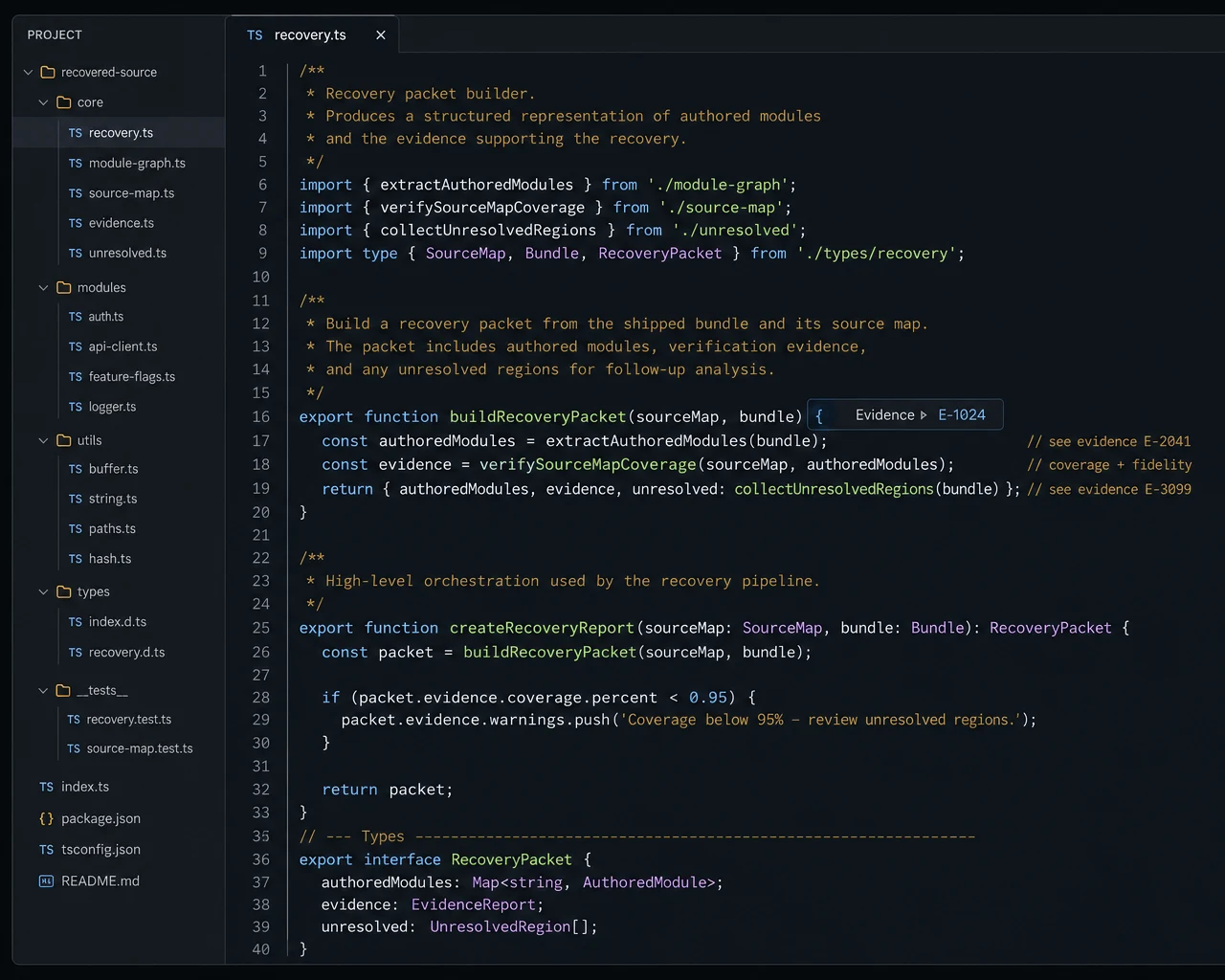
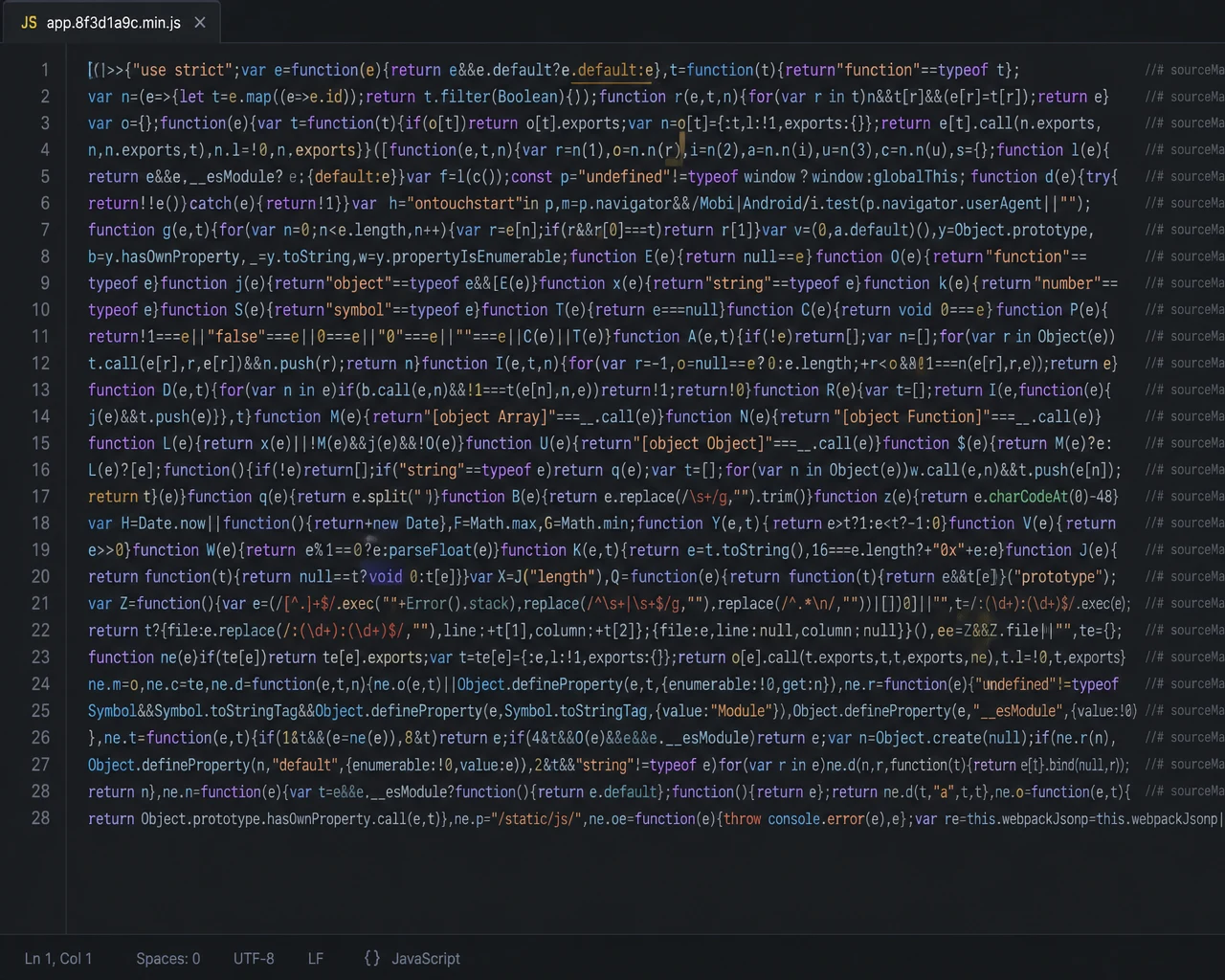
Move from shipped bundle to structured source.

Compare the kind of artifact KodeBack starts with against the structured candidate it can produce after source-map, bundle, and behavior analysis.

Illustrative readable recovered source with structured modules and named functions
Illustrative minified JavaScript bundle with mangled variables and dense generated code

Drag the divider or use the arrow keys to inspect both source surfaces.

Illustrative interface only. Actual recovery output depends on the captured application, available source maps, runtime evidence, and the declared scope.

Recovery, not recreation

Start from the software that exists—not from a screenshot and a guess.

A coding agent can recreate a screen from a prompt. That does not tell it which assets were loaded lazily, which request changed state, which storage key survives a reload, which package version shipped, which WebSocket frame initialized the scene, or which short string is an external contract.

KodeBackbegins by preserving the deployed application as evidence. Recovery proceeds through bounded stages that can be checked, recorded, retried, or refused.

Hover to inspect the handoff

Readable source is only the beginning of a trustworthy recovery.

A recovered workspace is valuable when the handoff explains the limits of the source, the behavior, and the remaining uncertainty.

Evidence boundary

The candidate remains tied to captured routes, runtime observations, dependency findings, protected contracts, and an explicit unresolved-region matrix.

Recovery toolchain

Source recovery needs a workspace that can hold the donor, the evidence, and the candidate.

KodeBack’s research context spans deterministic capture, browser inspection, visual/runtime evidence, and source analysis. The React Bits mark identifies the visual reference for this surface; it is not a runtime dependency of the recovery pipeline.

01 · donor

Capture first.

Preserve the shipped artifact before interpretation changes the evidence surface.

02 · analysis

Classify what shipped.

Separate application code, generated output, runtime behavior, and vendor regions before cleanup.

03 · handoff

Make uncertainty usable.

Deliver an editable candidate with the remaining seams, limits, and next actions visible.

Process preview

Recover facts first. Ask for judgment second.

01

Preserve the donor

Capture the deployed application, its assets, routes, runtime environment, requests, storage, and supported realtime behavior into an immutable evidence surface.

02

Classify the recovery route

Determine whether the application is source-map-first, readable-bundle, blind, or hybrid. Do not force every application through the same path.

03

Separate app code from shipped dependencies

Fingerprint vendor families, exact or likely versions, bundler runtime, modified vendor code, and ambiguous regions before cleanup.

04

Protect behaviorally important surfaces

Inventory routes, storage keys, event names, serialized fields, asset paths, shader strings, extension contracts, IPC channels, and other contracts.

05

Recover a runnable candidate

Promote trustworthy source maps, lift readable bundles where appropriate, retain uncertain bytes when necessary, and mutate only when evidence supports it.

06

Compare the candidate with captured truth

Run configured smoke, boundary, behavior, browser, scene, console, network, and project checks for the declared states.

07

Deliver an honest handoff

Package the editable workspace, evidence, change history, remaining seams, and next actions so the next engineer does not restart from bundle archaeology.

Use cases

The product is for ownership problems—not copying problems.

Recover after a failed vendor handoff

Establish what production actually contains before another agency or internal team takes ownership.

Reconcile production and repository drift

Determine whether the repository can reproduce the deployed product and recover missing client-side changes where supported.

Prepare modernization without a blind rewrite

Capture behavior and dependencies before replacing frameworks, build systems, or runtime surfaces.

Recover Electron or browser-extension software

Treat host startup, preload, IPC, extension contexts, service-worker lifetime, and packaged resources as first-class evidence.

Retain one critical capability

Declare the behavior that must remain, then remove or replace unwanted capabilities through a scoped, evidence-backed plan.

What the assessment returns

Buy clarity before committing to a recovery.

The assessment is valuable even when full recovery is not advisable.

  • donor and capture inventory
  • application and deployment profile
  • source-map and bundle-route analysis
  • dependency and vendor findings
  • runtime, storage, network, asset, and service-worker surfaces
  • protected-contract inventory
  • recoverable, ambiguous, retained, and unsupported regions
  • recommended scope and validation plan
  • security and data-handling constraints
  • a recommendation to proceed, narrow scope, collect more evidence, or stop
Request an assessment

Honest limits

Recovery is not the same as recovering history.

KodeBackdoes not need the original developer’s exact variable names to produce useful source. It also cannot recover facts that were never shipped or observed. A strong result is a candidate that is editable and independently runnable for the declared scope, with important contracts protected, captured states evidenced, dependencies clearer, and residual uncertainty explicit.

The Kalu Kode product family

Preserve. Recover. Remember. Control.

Four distinct products share one evidence-first philosophy and remain independently useful.

Take the next step

What still runs? What source still exists? What changed in between?

Tell us about the application, the authorization you have, and the outcome you need. We will determine whether a scoped assessment is appropriate before proposing a larger engagement.